¿Cómo usa el Tribunal Constitucional la inteligencia artificial?
Por Vélgika Rafaele Bautista y Rommel Infante AstoLima, 20 de noviembre de 2026 · 11 min de lectura
Versión de divulgación del Diagnóstico de gobernanza de IA del SIGE (Empatia Lab, setiembre de 2026).
Imagen 1. «Presidente del TC apuesta por la inteligencia artificial para reducir la carga procesal». Fuente: RPP, youtube.com/watch?v=X0b6QLZHqJg
Resumen
El Tribunal Constitucional ya usa inteligencia artificial (IA) para trabajar los expedientes de amparo, hábeas corpus y hábeas data. El sistema decide qué casos se proponen para el Pleno y redacta una parte de los proyectos de sentencia. Hasta setiembre de 2026 había procesado 5055 expedientes. El Tribunal tiene un protocolo propio y revisión humana en tres niveles, pero no puede demostrar que sus controles funcionen: no clasificó el riesgo del sistema, envía los expedientes completos a un proveedor extranjero sin anonimizarlos, no registra las correcciones que hace su personal y no avisa a las partes. Este artículo explica esos hallazgos en lenguaje claro y propone qué puede hacer cada usuario del sistema de justicia.
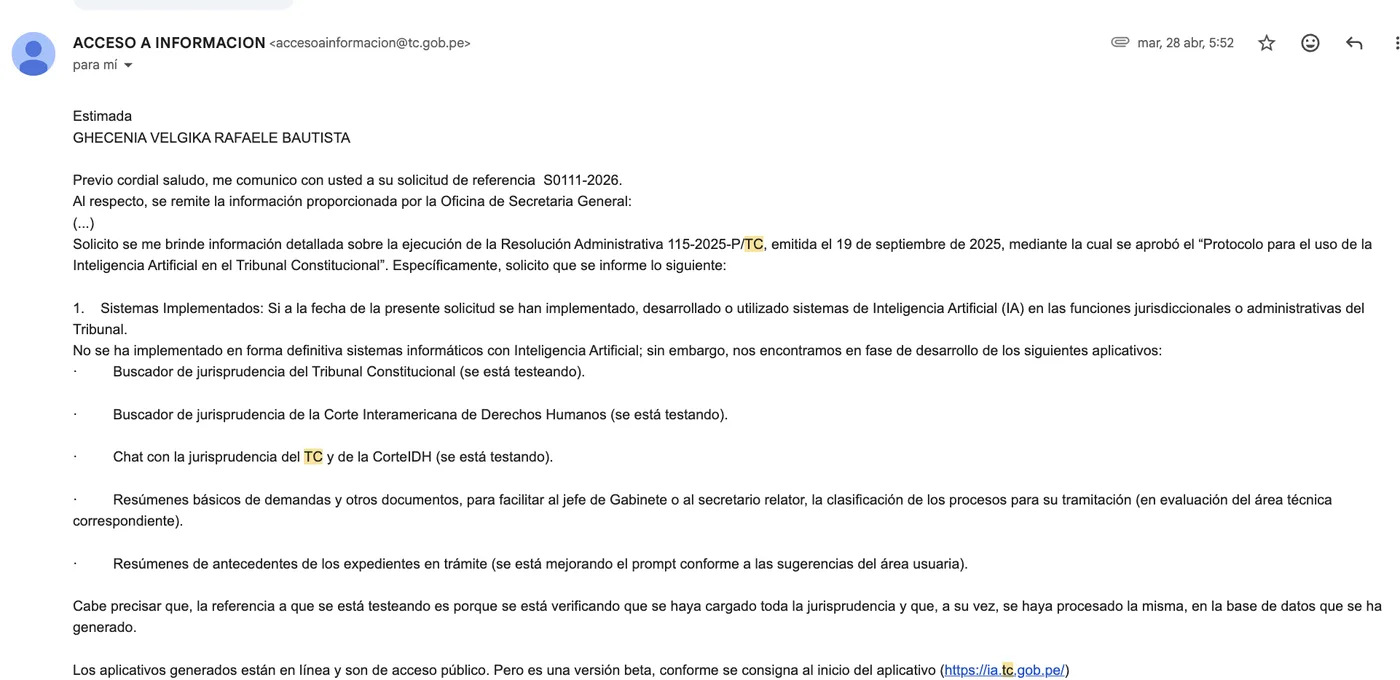
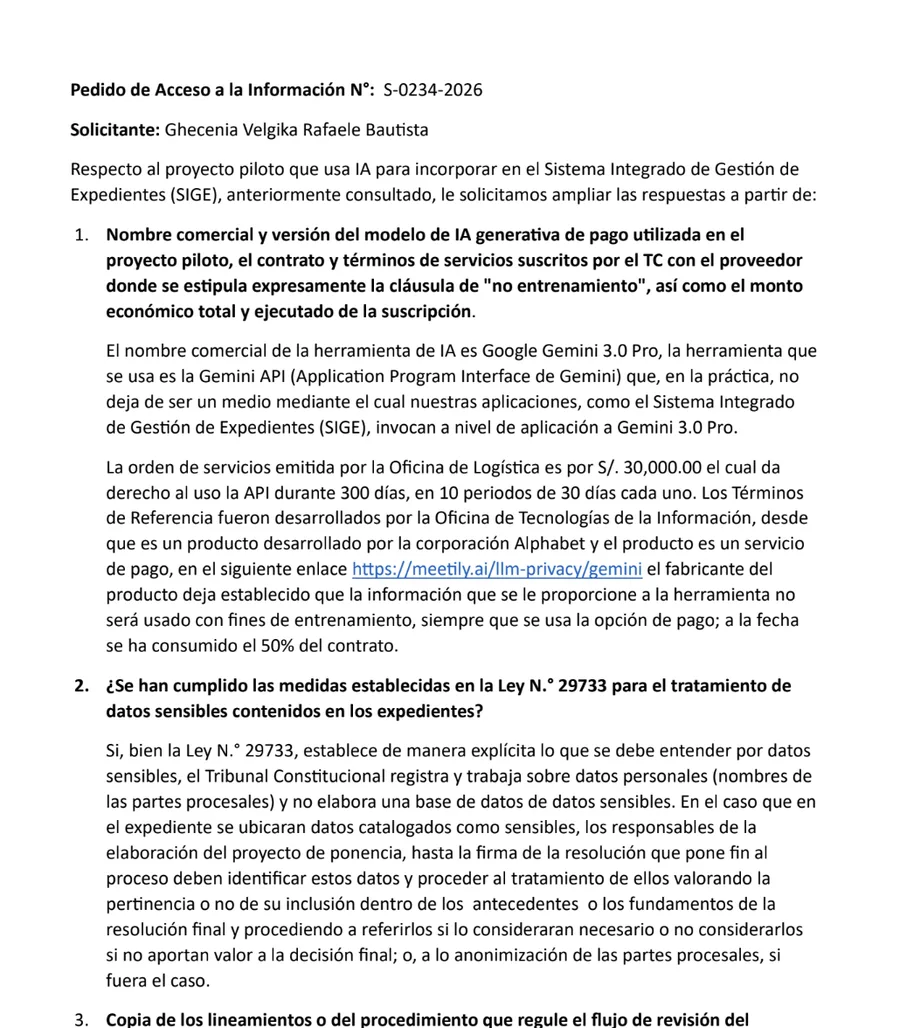
Ese anuncio confirmó lo que Empatia Lab venía investigando. Durante los últimos seis meses solicitamos al Tribunal información pública sobre cómo integra la IA en su trabajo. Obtuvimos tres respuestas: las de las solicitudes de acceso a la información pública (SAIP) N.° S0111-2026 y N.° S0234-2026, y los comentarios de su Oficina de Tecnologías de la Información (OTI) del 17 de setiembre de 2026, enviados tras una reunión de trabajo el día 7 de ese mes. Con ese material, el Protocolo para el uso de la IA del Tribunal y una consulta al Registro Nacional de Protección de Datos Personales, elaboramos un diagnóstico técnico-jurídico (Empatia Lab, 2026). Este documento es su versión para el público.
Conviene precisar los límites: no tuvimos acceso al sistema, a su documentación técnica ni al contrato con el proveedor. Es una revisión documental, no una auditoría, y se basa en lo que el Tribunal informó y en lo que puede verificarse en registros públicos (Empatia Lab, 2026, p. 5).
Imagen 2. Correo de respuesta a la primera SAIP (N.° S0111-2026).Imagen 3. Carta de respuesta a la segunda SAIP (N.° S0234-2026).
II. Qué hace la inteligencia artificial en el Tribunal
El sistema forma parte del Sistema Integrado de Gestión de Expedientes (SIGE) y cumple dos funciones (Empatia Lab, 2026, pp. 6-7):
Clasificar y derivar. Lee el expediente y propone si debe resolverlo una Sala o el Pleno, según considere que el caso es complejo o de alto interés público. La propuesta llega al jefe del gabinete de asesores.
Resumir y redactar. Con la demanda, las sentencias de primera y segunda instancia y el recurso de agravio constitucional, redacta la sección de antecedentes del proyecto de sentencia. Usa una técnica llamada generación aumentada por recuperación: el modelo escribe apoyándose en los documentos cargados. El Tribunal proyecta extenderlo a la sección de fundamentos, donde está el razonamiento jurídico que sostiene el fallo.
Un proyecto piloto de IA dentro del Sistema Integrado de Gestión de Expedientes (SIGE).
¿Qué hace?
Propone si un expediente va a una Sala o al Pleno, y redacta los «antecedentes» del proyecto de sentencia.
¿Cuántos casos?
5055 expedientes: todos los procesos de tutela ingresados.
¿Con qué modelo?
Gemini 3.0 Pro de Google, mediante API (orden de servicio por S/ 30 000 por 300 días).
¿Quién revisa?
El asesor, el jefe del gabinete de asesores y el magistrado que firma.
¿Qué falta?
Registros de evaluación y de correcciones que acrediten que existió supervisión, clasificación de riesgo y aviso a las partes.
Tabla 1. Datos clave informados por el Tribunal. Fuente: Empatia Lab (2026, p. 7).
III. Lo que encontramos
Primero, lo positivo. El Tribunal aprobó un Protocolo para el uso de la IA (Resolución Administrativa N.° 115-2025-P/TC), incluyó estos proyectos en su Plan de Gobierno y Transformación Digital 2026-2028 y diseñó el sistema para que nada pase automáticamente al proyecto de sentencia: tres personas revisan antes de la firma. El problema es que esos controles existen según su normativa, pero no están documentados ni tienen mecanismos visibles. Estos son los cinco hallazgos principales:
3.1. Nivel de riesgo del sistema
Desde setiembre de 2026 es exigible al Tribunal el Reglamento de la Ley N.° 31814 (Decreto Supremo N.° 115-2025-PCM), que ordena las obligaciones según el riesgo de cada sistema. Su artículo 24.1, literal j, considera de riesgo alto los usos que ponen en juego derechos fundamentales, como ocurre en los procesos de tutela. En ese caso, el artículo 30 exige una evaluación de impacto antes de desplegar el sistema. No consta que el Tribunal haya clasificado el sistema ni hecho esa evaluación, pese a que ya opera sobre todos los casos de tutela ingresados. Tampoco se indicó en la reunión sostenida.
3.2. ¿Hasta dónde puede “ayudar” la máquina a redactar una sentencia?
El Protocolo permite el apoyo de la IA para redactar proyectos a partir de antecedentes (artículo 6.1), pero prohíbe que sustituya el análisis jurídico y la valoración de la prueba (artículo 7.1). Entre ambos hay una zona gris que el Protocolo no delimita y que se cruzaría si el sistema pasa a redactar los fundamentos. En realidad, no tenemos claros los límites: al ser una API de Gemini, el aplicativo no tiene restricciones técnicas en cuanto a su uso y, al ser consultado, el Tribunal no informó que esta API tenga restricciones técnicas para la formulación de fundamentos. Las Directrices de la UNESCO para el uso de sistemas de IA en cortes y tribunales piden que la IA no reemplace el análisis independiente del juez, y la Corte Constitucional de Colombia (Sentencia T-323 de 2024) admitió el uso de IA en la justicia solo si no sustituye el juicio humano.
El Tribunal tiene un protocolo propio y revisión humana en tres niveles, pero no puede demostrar que sus controles funcionen.
3.3. Datos personales
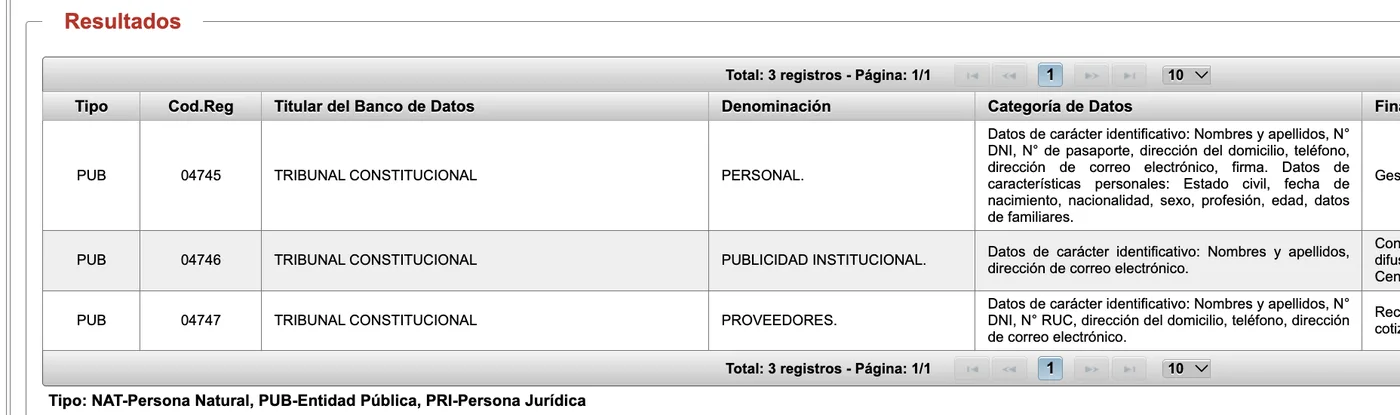
Los expedientes se envían íntegros al proveedor, sin anonimizar ni reducir los datos personales de las partes y de terceros. El Tribunal no ha comunicado ese flujo internacional a la autoridad de protección de datos y no ha inscrito el banco de datos de expedientes en el Registro Nacional, como exige el Reglamento de la Ley N.° 29733 (Decreto Supremo N.° 016-2024-JUS) (Empatia Lab, 2026, pp. 9-10).
Imagen 4. Bancos de datos personales registrados por el Tribunal Constitucional, a noviembre de 2026. Fuente: Registro Nacional de Protección de Datos Personales.
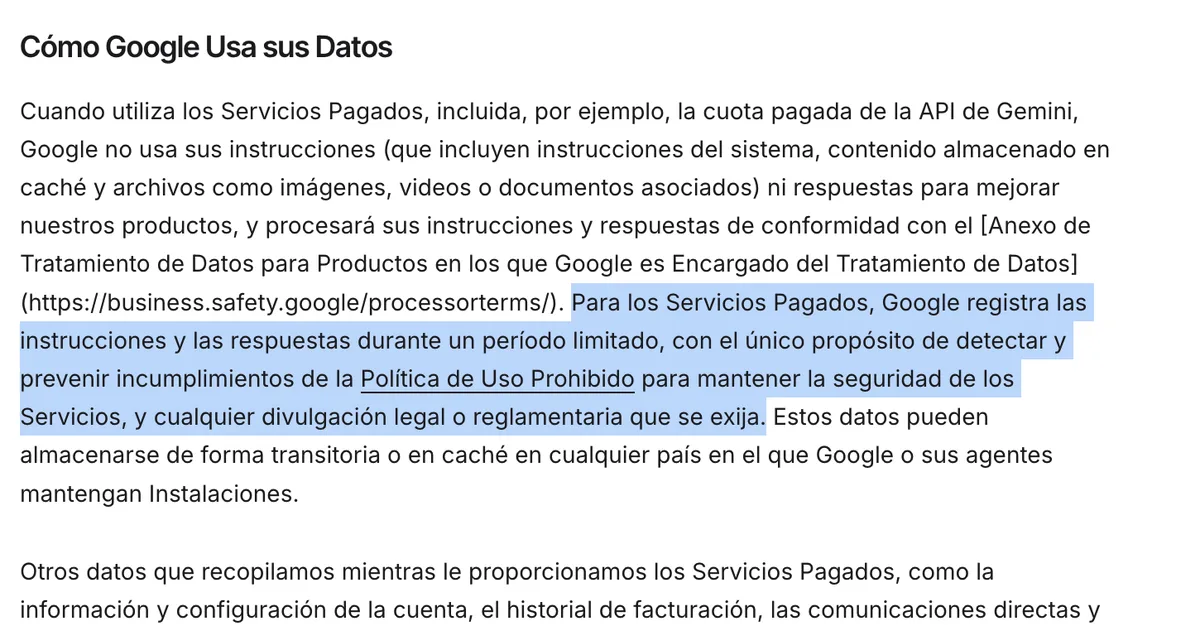
Para afirmar que los datos no se usan para entrenar modelos, el Tribunal remitió una página web de un tercero, no el contrato. Los términos del servicio de pago de la API de Gemini sí prevén esa exclusión, pero la garantía debe constar en el instrumento que vincula al Tribunal con el proveedor, junto con la finalidad, la conservación de los datos y la facultad de auditoría. Además, resaltamos que, aun en la versión de pago, Google sí almacena la información y la respuesta del usuario:
Imagen 5. Extracto de los términos de servicio de la API de Gemini. Fuente: Google, ai.google.dev/terms
3.4. Revisión humana no medible
El SIGE registra por dónde pasa cada expediente, pero no qué corrigió el asesor ni cuándo descartó lo que propuso la máquina. Tampoco hay registros de evaluación: solo se revisa la «coherencia narrativa» y la «claridad». Sin esos datos no se puede calcular una tasa de error. El artículo 28.11 del Reglamento exige que, en el sector justicia, el personal esté capacitado para no dejarse llevar por el sistema y pueda detenerlo, corregirlo o invalidarlo. El Informe preliminar del Panel Científico Internacional de la ONU sobre IA (julio de 2026) advierte que, en general, la supervisión humana todavía no funciona como un requisito medible.
Por tanto, confiar en la supervisión humana como una vía eficiente de control, sin una metodología clara, implica un riesgo, y en este punto es necesario pensar en el error. Si un tribunal de primera instancia se equivoca al no supervisar bien el trabajo de la inteligencia artificial, el error puede eventualmente subsanarse en vía recursal. Sin embargo, ante el Tribunal Constitucional, que es la última sede de la justicia constitucional, el justiciable no tendrá forma de controvertir lo que se ha determinado sin una adecuada supervisión humana.
3.5. Usted no sabe que su expediente pasó por la IA
El artículo 8.3 del Protocolo dispone que se informará a la ciudadanía del uso de la IA en los procesos en trámite, y el artículo 25 del Reglamento exige transparencia previa, clara y sencilla en los sistemas de riesgo alto. No existe ningún mecanismo para avisar a las partes, aunque ya se procesaron 5055 expedientes.
IV. Qué puede hacer usted
Si usted es parte, abogado o abogada en un proceso ante el Tribunal Constitucional, puede tomar estas medidas:
Preguntar. Presente una solicitud de acceso a la información pública para saber si su expediente fue procesado con IA y qué funciones se aplicaron.
Verificar los antecedentes. Compare la sección de antecedentes de la sentencia con lo que usted alegó. Si falta un hecho relevante, señálelo por los medios procesales que correspondan.
Ejercer sus derechos sobre sus datos. La Ley N.° 29733 le permite pedir información sobre el tratamiento de sus datos personales, su destinatario y su transferencia.
Exigir el aviso previo. Invoque el artículo 8.3 del Protocolo y el artículo 25 del Reglamento de la Ley N.° 31814 para pedir que se le informe del uso de IA.
V. Lo que recomendamos al Tribunal
El diagnóstico formula diez recomendaciones (Empatia Lab, 2026, pp. 9-17) y se remitió al Tribunal en setiembre de 2026. Las agrupamos en cinco prioridades:
Clasificar el riesgo y evaluar el impacto antes de ampliar el piloto a los fundamentos o de lanzar los cuatro aplicativos en diseño, y delimitar por escrito qué partes del proyecto puede redactar la IA.
Proteger los datos desde el diseño: minimizar o disociar la información antes de enviarla, definir el país de procesamiento, inscribir el banco de datos y firmar una cláusula de encargo de tratamiento que excluya el entrenamiento.
Hacer visible la supervisión: registrar cada corrección (hecho omitido, cita inexacta, pretensión mal identificada) y medir la precisión y los sesgos de ambas funciones.
Informar a las partes y habilitar una vía para pedir explicaciones y cuestionar el resultado.
Ordenar la gobernanza interna: actualizar el Protocolo con los principios del Reglamento, formar un equipo multidisciplinario responsable, adoptar la norma NTP-ISO/IEC 42001:2025 y aprobar el Plan de Acción de Gobierno de Datos que exige la Estrategia Nacional de IA 2026-2030. Desde octubre, la PCM ya fijó el perfil del Oficial de Inteligencia Artificial, que el Tribunal debe designar.
VI. Conclusión
Solemos pensar que las medidas de seguridad son gastos o inconvenientes para el funcionamiento de un sistema algorítmico. Sin embargo, basta mirar los impactos de la ausencia de seguridad en el tratamiento de la inteligencia artificial a nivel mundial: la seguridad que no viene primero tendrá que llegar después, cuando el daño ya haya ocurrido.
Este no es un caso de desinterés: el Tribunal tiene un protocolo, revisión humana y la voluntad declarada de que la IA no reemplace a los jueces. Pero en materia de derechos fundamentales las buenas intenciones deben poder demostrarse. No en vano se trata del más alto tribunal de justicia constitucional de nuestro país, que además revisa, en sede de amparo y en sede competencial, las decisiones del Poder Judicial. Hoy, quien acude al Tribunal no sabe que una máquina participó en su caso, no sabe adónde viajaron sus datos y no puede comprobar que alguien corrigió lo que la máquina escribió. Es el momento de incorporar los controles: ahora, y no después de que el sistema se convierta en la forma ordinaria de hacer justicia constitucional.
How does the Constitutional Court use artificial intelligence?
By Vélgika Rafaele Bautista and Rommel Infante AstoLima, 20 November 2026 · 11 min read
Public-facing version of the AI Governance Diagnostic of the SIGE (Empatia Lab, September 2026).
Image 1. “President of the TC bets on artificial intelligence to reduce the caseload”. Source: RPP, youtube.com/watch?v=X0b6QLZHqJg
Summary
The Constitutional Court already uses artificial intelligence (AI) to process amparo, habeas corpus and habeas data cases. The system decides which cases are proposed to the Full Court and drafts part of the draft judgments. By September 2026 it had processed 5,055 case files. The Court has its own protocol and three levels of human review, but it cannot show that its controls work: it did not classify the system's risk, it sends complete case files to a foreign provider without anonymising them, it does not record the corrections its staff make, and it does not notify the parties. This article explains these findings in plain language and proposes what each user of the justice system can do.
That announcement confirmed what Empatia Lab had been investigating. Over the past six months we requested public information from the Court on how it integrates AI into its work. We obtained three responses: those to access-to-public-information requests (SAIP) No. S0111-2026 and No. S0234-2026, and the comments of its Information Technology Office (OTI) dated 17 September 2026, sent after a working meeting on the 7th of that month. With that material, the Court's Protocol for the use of AI and a search of the National Registry of Personal Data Protection, we prepared a technical and legal diagnostic (Empatia Lab, 2026). This document is its version for the public.
The limits should be clear: we had no access to the system, its technical documentation or the contract with the provider. This is a documentary review, not an audit, and it relies on what the Court reported and on what can be verified in public records (Empatia Lab, 2026, p. 5).
Image 2. Email response to the first access-to-information request (No. S0111-2026).Image 3. Letter responding to the second access-to-information request (No. S0234-2026).
II. What artificial intelligence does at the Court
The system is part of the Integrated Case Management System (SIGE) and performs two functions (Empatia Lab, 2026, pp. 6–7):
Classify and route. It reads the case file and proposes whether a Chamber or the Full Court should decide it, depending on whether it considers the case complex or of high public interest. The proposal goes to the head of the advisers' office.
Summarise and draft. Using the claim, the first- and second-instance judgments and the constitutional grievance appeal (recurso de agravio constitucional), it drafts the background section of the draft judgment. It uses a technique called retrieval-augmented generation: the model writes based on the uploaded documents. The Court plans to extend it to the legal grounds section, which contains the legal reasoning behind the ruling.
An AI pilot project within the Integrated Case Management System (SIGE).
What does it do?
Proposes whether a case goes to a Chamber or the Full Court, and drafts the “background” of the draft judgment.
How many cases?
5,055 case files: all constitutional protection proceedings filed.
Which model?
Google's Gemini 3.0 Pro, via API (service order for S/ 30,000 for 300 days).
Who reviews?
The adviser, the head of the advisers' office and the justice who signs.
What is missing?
Evaluation and correction logs showing that oversight took place, risk classification, and notice to the parties.
Table 1. Key data reported by the Court. Source: Empatia Lab (2026, p. 7).
III. What we found
First, the positives. The Court approved a Protocol for the use of AI (Administrative Resolution No. 115-2025-P/TC), included these projects in its Digital Government and Transformation Plan 2026–2028, and designed the system so that nothing passes automatically into the draft judgment: three people review it before signature. The problem is that these controls exist on paper but are not documented and have no visible mechanisms. These are the five main findings:
3.1. The system's risk level
Since September 2026 the Court has been bound by the Regulation of Law No. 31814 (Supreme Decree No. 115-2025-PCM), which sets obligations according to each system's risk. Its article 24.1(j) treats as high-risk those uses that put fundamental rights at stake, as is the case in constitutional protection proceedings. For such systems, article 30 requires an impact assessment before deployment. There is no record that the Court has classified the system or carried out that assessment, even though it already runs on every constitutional protection case filed. Nor was this mentioned at the meeting held.
3.2. How far can the machine “help” draft a judgment?
The Protocol allows AI support to draft projects based on the background (article 6.1), but prohibits it from replacing legal analysis and the assessment of evidence (article 7.1). Between the two lies a grey area that the Protocol does not define, and that would be crossed if the system started drafting the legal grounds. In fact, the limits are not clear to us: being a Gemini API, the application has no technical restrictions on its use and, when asked, the Court did not report any technical restriction on this API drafting legal grounds. The UNESCO Guidelines for the use of AI systems in courts and tribunals call for AI not to replace the judge's independent analysis, and the Constitutional Court of Colombia (Judgment T-323 of 2024) accepted the use of AI in the justice system only where it does not replace human judgment.
The Court has its own protocol and three levels of human review, but it cannot show that its controls work.
3.3. Personal data
Case files are sent to the provider in full, without anonymising or minimising the personal data of the parties and third parties. The Court has not notified this international transfer to the data protection authority and has not registered its case-file database in the National Registry, as required by the Regulation of Law No. 29733 (Supreme Decree No. 016-2024-JUS) (Empatia Lab, 2026, pp. 9–10).
Image 4. Personal databases registered by the Constitutional Court, as of November 2026. Source: National Registry of Personal Data Protection.
To claim that the data are not used to train models, the Court pointed to a third party's web page, not the contract. The terms of the paid Gemini API service do provide for that exclusion, but the guarantee must appear in the instrument that binds the Court to the provider, together with the purpose, data retention and the right to audit. We also note that, even on the paid tier, Google does store the user's inputs and responses:
Image 5. Excerpt from the Gemini API terms of service (Spanish version). Source: Google, ai.google.dev/terms
3.4. Human review that cannot be measured
The SIGE records where each case file goes, but not what the adviser corrected or when they discarded what the machine proposed. Nor are there evaluation logs: only “narrative coherence” and “clarity” are reviewed. Without those data, no error rate can be calculated. Article 28.11 of the Regulation requires that, in the justice sector, staff be trained not to be carried along by the system and be able to stop, correct or override it. The Preliminary Report of the UN Independent International Scientific Panel on AI (July 2026) warns that, in general, human oversight does not yet work as a measurable requirement.
Relying on human oversight as an effective control without a clear methodology therefore carries a risk, and at this point we need to think about error. If a first-instance court errs by failing to supervise the AI's work properly, the error may eventually be corrected on appeal. Before the Constitutional Court, however, which is the court of last resort in constitutional matters, litigants will have no way to challenge what was decided without adequate human oversight.
3.5. You don't know your case file went through AI
Article 8.3 of the Protocol provides that the public will be informed of the use of AI in pending proceedings, and article 25 of the Regulation requires prior, clear and simple transparency for high-risk systems. There is no mechanism to notify the parties, even though 5,055 case files have already been processed.
IV. What you can do
If you are a party, or a lawyer, in proceedings before the Constitutional Court, you can take these steps:
Ask. File an access-to-public-information request to find out whether your case file was processed with AI and which functions were applied.
Check the background. Compare the background section of the judgment with what you argued. If a relevant fact is missing, raise it through the appropriate procedural means.
Exercise your rights over your data. Law No. 29733 allows you to request information about the processing of your personal data, who receives it and where it is transferred.
Demand prior notice. Invoke article 8.3 of the Protocol and article 25 of the Regulation of Law No. 31814 to ask to be informed of the use of AI.
V. What we recommend to the Court
The diagnostic sets out ten recommendations (Empatia Lab, 2026, pp. 9–17) and was sent to the Court in September 2026. We group them into five priorities:
Classify the risk and assess the impact before extending the pilot to the legal grounds or launching the four applications in design, and set out in writing which parts of the draft the AI may write.
Protect data by design: minimise or de-identify information before sending it, define the country of processing, register the database and sign a data-processor clause that excludes training.
Make oversight visible: log every correction (omitted fact, inaccurate citation, misidentified claim) and measure the accuracy and biases of both functions.
Inform the parties and provide a channel to request explanations and challenge the outcome.
Put internal governance in order: update the Protocol with the Regulation's principles, set up a responsible multidisciplinary team, adopt the NTP-ISO/IEC 42001:2025 standard and approve the Data Governance Action Plan required by the National AI Strategy 2026–2030. Since October, the PCM has set the profile of the Artificial Intelligence Officer, whom the Court must appoint.
VI. Conclusion
We tend to see safety measures as costs or obstacles to running an algorithmic system. Yet we need only look at the impact of missing safeguards in AI around the world: safety that does not come first will have to come later, once the harm has already been done.
This is not a case of indifference: the Court has a protocol, human review and a stated commitment that AI will not replace judges. But where fundamental rights are at stake, good intentions must be demonstrable. This is, after all, the highest court of constitutional justice in our country, which also reviews decisions of the Judiciary in amparo and jurisdictional-dispute proceedings. Today, anyone who comes before the Court does not know that a machine took part in their case, does not know where their data went, and cannot verify that anyone corrected what the machine wrote. The time to build in these controls is now, not after the system has become the ordinary way of delivering constitutional justice.